
The Vienna Royal Orchestra: a guide to the evening
One programme, three rooms and an orchestra that brings its own soprano and dancers — this is what an evening with the Wiener Royal Orchester holds.
By the Vienna Evening counter — the people who book the seats
Updated · 7 min read
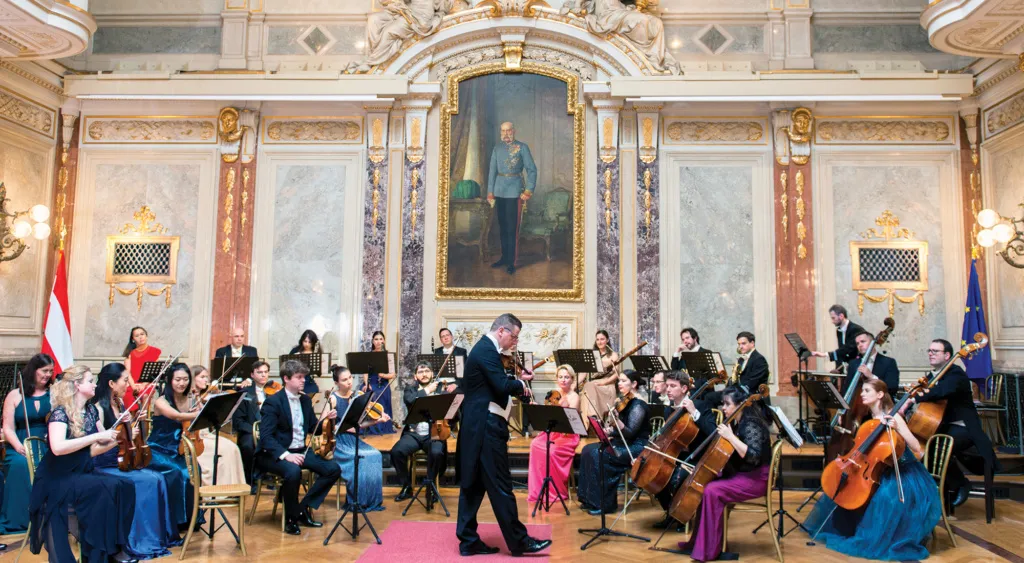
The Wiener Royal Orchester — the Vienna Royal Orchestra in English — is one of the resident ensembles that play Vienna’s best-known music in historic rooms in the city centre. It is a salon orchestra rather than a symphony orchestra: violins at its heart, with piano, double bass, cello, flute, clarinet and drums, a soprano who steps forward for the arias and dancers for the waltzes.
Who plays
The orchestra’s own roster names twenty musicians, six singers and four dancers. At the front stands Michal Hudak, its concertmaster and music arranger since 2012. He was concertmaster of the State Opera in Slovakia from 2005 to 2015, and since 2018 he has also been concertmaster of the Opera Symphony Orchestra Vienna and first violin of his own Hudak Ensemble Vienna. He takes the solo violin and directs the evening from it, and the programme is his arrangement.
The soprano is Anna Ryan, whose list of stages runs from the Musikverein and the Konzerthaus in Vienna to the Teatro Colón in Buenos Aires and the Tokyo City Opera Hall. Beside her the orchestra names two more sopranos, a tenor, a baritone and a bass-baritone, and four dancers for the ballet numbers. Who sings and dances on a given night is the orchestra’s choice; its programme note keeps the right to change it.
The programme, part by part
The orchestra plays one programme and prints it in full: two parts with an interval between them, from a Mozart overture to the Blue Danube. Because it is the same from night to night, the choice in front of you is the room and the seat, not the music.
- IMozart opensThe overture to Le nozze di Figaro, then “Io son l’umile ancella” from Cilea’s Adriana Lecouvreur for the soprano.
- Vivaldi, Mozart and SchubertA selection from The Four Seasons, Eine kleine Nachtmusik and Schubert’s Moments musicaux.
- Strauss and BrahmsJohann Strauss II’s Morgenblätter and his Neue Pizzicato-Polka, and Brahms’s Hungarian Dance No. 5 to close the first part.
- IntervalThe one interval the programme marks, between the two parts.
- IIMarches and LinckeThe Vaterländischer Marsch of Johann and Josef Strauss, then Paul Lincke’s Winter-Landschaft and Fritzi und Fritze.
- Il bacio, then thunderLuigi Arditi’s Il bacio for the soprano, and Strauss’s polka Unter Donner und Blitz.
- A tango, then the DanubeMichal Hudak’s own tango medley — Leroy Anderson’s Blue Tango into Verdi’s La traviata — and An der schönen blauen Donau to finish.
Because it is the same from night to night, the choice in front of you is the room and the seat, not the music.
Why it ends on the Danube
The city’s own history wiki tells how the last waltz earned its place. Johann Strauss II wrote An der schönen blauen Donau for the Wiener Männergesang-Verein, and its first performance, on 15 February 1867 in the hall of the old Dianabad, was the choral version, with words that poked fun at the times. Months later Strauss played it at the World Exhibition in Paris as Le beau Danube bleu, and that is where its career began. By the wiki’s account it went on to become Vienna’s secret anthem.
Three rooms at two addresses
The orchestra plays in three rooms. One is on Beethovenplatz in the first district, a few steps from the Ringstraße; the other two are under one roof on Schwarzenbergplatz, in the Haus der Industrie. Your booking names the room, and the two at Schwarzenbergplatz are worth telling apart before you go in.
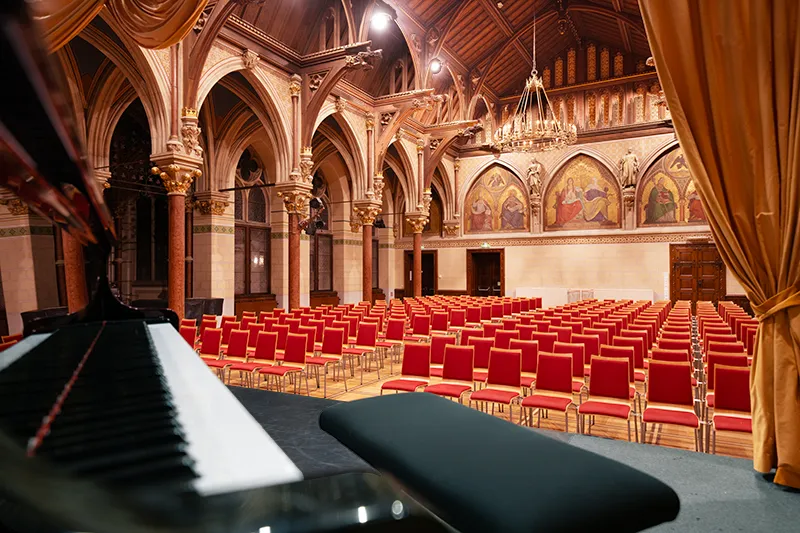
Imperial Hall
- Beethovenplatz 1, in the first district
- Neo-Gothic: pointed arches, painted panels and dark timber
- The orchestra’s own pages also call it the Gothic Hall
Friedrich Schmidt’s building for the Akademisches Gymnasium, opened in 1866.
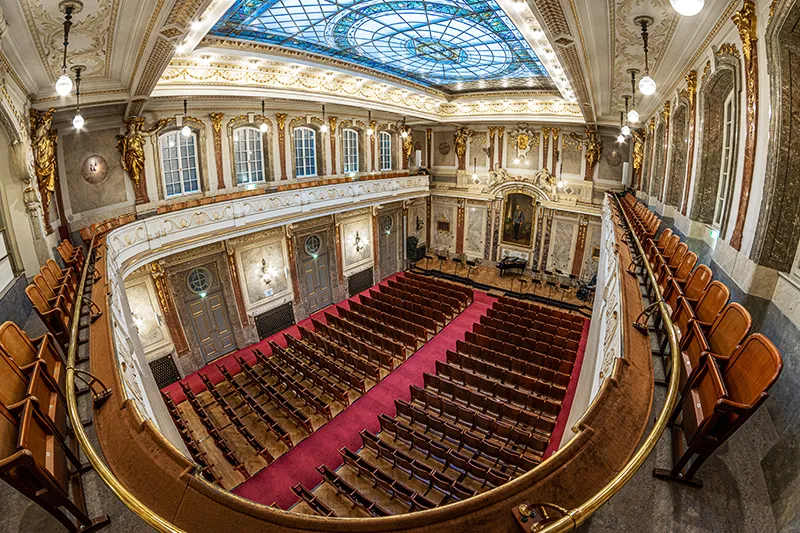
King’s Hall
- Haus der Industrie, Schwarzenbergplatz 4
- The building’s ballroom, with a gallery round the room
- Franz Joseph’s portrait looks down on the orchestra
Built by Karl König and opened by Franz Joseph I on 5 March 1911.
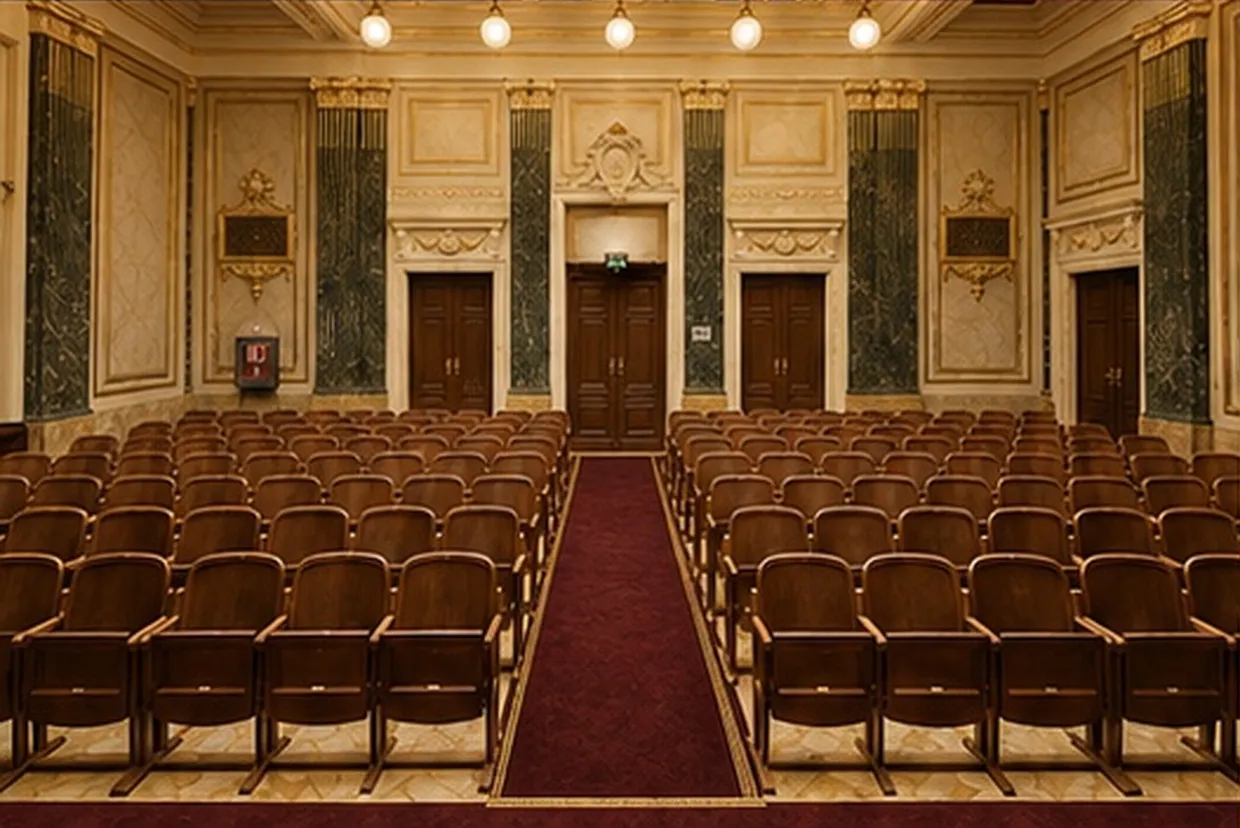
Festsaal II
- The same building as the King’s Hall
- A smaller room the orchestra calls intimate
- Rows either side of a centre aisle
Two rooms, one building: check which your booking names.
Two buildings with a past
Neither address was built for concerts, and both have more history than the evening needs — but it is a good story to have in your head when you sit down.
- 1552A school is foundedThe Jesuits open the Akademisches Gymnasium, the city’s first grammar school and today its oldest.
- 1866BeethovenplatzThe school moves into the neo-Gothic building Friedrich Schmidt designed for it, opened on 17 October. Schmidt was cathedral architect of St Stephen’s from 1862 and the architect of the City Hall.
- 1911SchwarzenbergplatzFranz Joseph I opens the Haus der Industrie, built by Karl König between 1907 and 1909, on 5 March. A plaque in the vestibule records it.
- 1945The Allied CouncilAfter the war the four occupying powers meet in the building from 11 September, and on 20 October recognise Karl Renner’s provisional government there.
- 1955Before the State TreatyThe preparatory talks are held in the house from 2 to 12 May, before the treaty is signed on 15 May. A second plaque in the vestibule marks them.
The Federation of Austrian Industries still has its seat in the Haus der Industrie, and the school still teaches at Beethovenplatz.
Choosing a room and a seat
- Choose the room firstWith one programme, the room is the real choice: the Imperial Hall for the Gothic arches, the King’s Hall for the grand ballroom, Festsaal II for the smallest and closest.
- Then the categoryFour categories — Imperial nearest the orchestra, then Gold, Silver and Bronze — and the plan on our page shows where each one sits in each room. In the King’s Hall, Gold also takes the gallery at the back.
- Book the party togetherThe house assigns the seats inside your category, so a party that wants to sit together should be on one order.
- Go to the right doorAt Schwarzenbergplatz two of the orchestra’s rooms share the building. Your booking names the one that is yours.
Book here
The Wiener Royal Orchester on Vienna Evening
The dates, the three rooms and the plan of each hall, with every category marked on it.
The orchestra’s site
royal-orchestra.com
The orchestra’s own site in six languages: its musicians, its programme and a page for each hall. Tickets there are sold by The Vienna Evening Company too, so either way the same people answer your questions.
Verification withheld
Which musicians, singers and dancers appear on a particular night.
The orchestra publishes its roster and its programme, not a line-up per night, and it keeps the right to change the casting.
The roster, the programme and the halls come from the orchestra’s own pages at royal-classic.at; the history of the two buildings and of the waltz from the City of Vienna’s Wien Geschichte Wiki and from the school’s own site, akg-wien.at — all read on 5 October 2026.
Concerts we sell this season
Every price is on the room’s own page, and it is the whole price. Open or sold out is read there, live.
Questions guests ask
Answered at the Vienna Evening counter.
- Who is the Vienna Royal Orchestra?
- The Wiener Royal Orchester is a resident salon orchestra in Vienna with its own singers and dancers, led from the violin by its concertmaster and music arranger, Michal Hudak. It plays one programme, from Mozart to Strauss, in three historic rooms in the city centre.
- What does the Vienna Royal Orchestra play?
- Mozart’s Figaro overture and Eine kleine Nachtmusik, a selection from Vivaldi’s Four Seasons, Schubert, Brahms, two pieces for the soprano and the Strauss waltzes and polkas, ending with the Blue Danube. Single works can change on the night.
- Is there an interval?
- Yes. The orchestra’s programme is in two parts, with one interval between them.
- Where does the Vienna Royal Orchestra play?
- In the Imperial Hall at Beethovenplatz 1, and in the King’s Hall and Festsaal II, both in the Haus der Industrie at Schwarzenbergplatz 4. Your booking names the room.
- Are the King’s Hall and Festsaal II the same room?
- No. They are two rooms in the same building, the Haus der Industrie. Check which one your booking names before you go in.
- Can I book on royal-orchestra.com instead?
- Yes. Tickets on royal-orchestra.com are sold by The Vienna Evening Company as well, so whichever site you book on, the same people answer your questions.
Read next
- The Long Night of the Museums in ViennaThe ORF Long Night of the Museums: one ticket, more than 120 Vienna museums open from 18:00 to midnight, the city’s transport included, and how to plan a route.5 minupdated 3 October 2026
- Why buying a Vienna ticket is harder than it looksRelease dates, allocations, resale and the street sellers in wigs: how tickets to Vienna’s houses actually reach a visitor, and where each route can go wrong.3 minupdated 27 August 2026
- Vienna’s concert halls, and how they actually differWhich room you sit in changes the evening more than which orchestra plays. A guide to how Vienna’s concert rooms differ in size, sound, seating and temperature.3 minupdated 27 August 2026